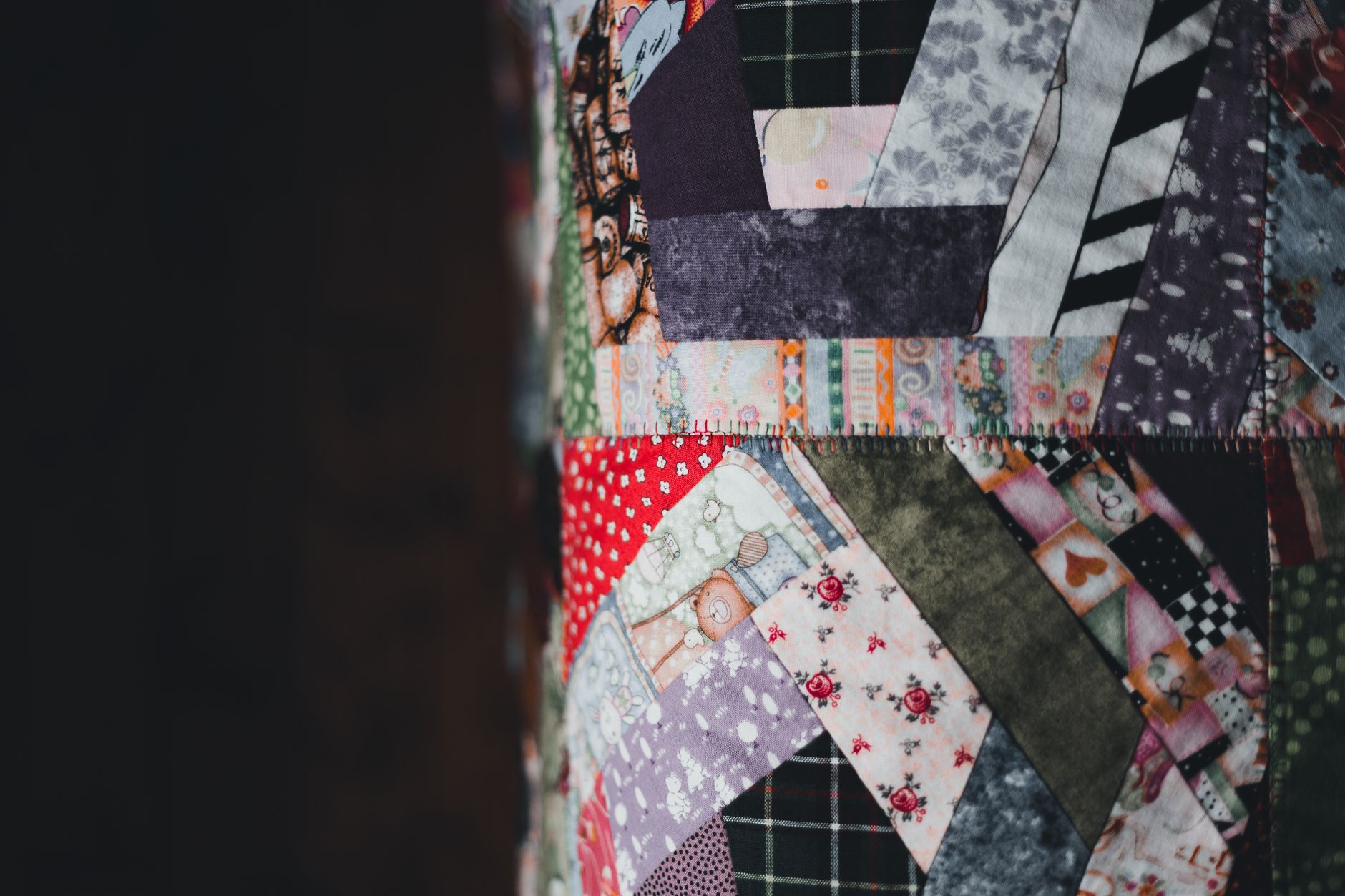
This film is my love letter to one of the strangest, most human theorems in all of mathematics — the four-color theorem: any map (or any quilt, which is a map stitched in cloth) can be colored with just four colors so that no two touching regions match.
The idea
My grandma laid out her patchwork by eye — but what she felt as instinct was a theorem. In 1852, Francis Guthrie noticed that four colors always seemed enough for any map of counties. Nobody could prove it. For 124 years, the best minds in the world tried and failed.
Then in 1976, Kenneth Appel and Wolfgang Haken finished it the only way it could be finished — by checking 1,936 cases on a computer. The first great theorem of mathematics to be proven by machine.
A sample quilt
Four colors — no two touching patches share one.
Why should any workshop girl of mine believe this? Because it's grounded — check the sources: the Wikidata entry, the full history. Real math is like a good quilt: it holds up because every seam is true.